Willkommen bei Flowtig
Eine modulare Business-Plattform, die mit Ihrer Organisation wächst.
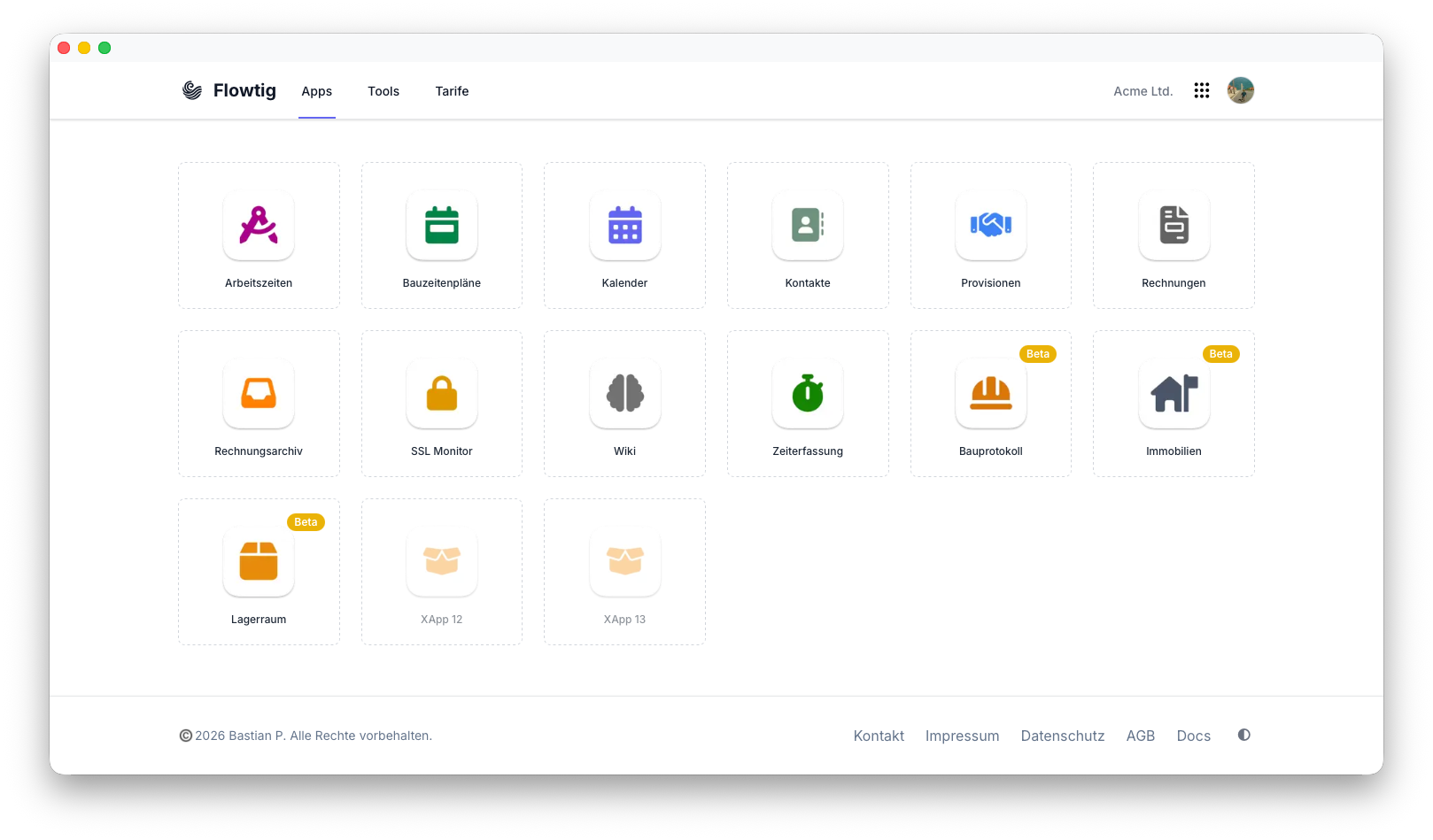
Flowtig ist eine modulare Business-Plattform, die aus unabhängigen Anwendungen besteht, die nahtlos zusammenarbeiten.
Anstatt jedes Unternehmen in eine einzige Komplettlösung zu zwingen, ermöglicht Flowtig Organisationen, genau die Anwendungen auszuwählen, die sie tatsächlich benötigen. Jede Anwendung konzentriert sich auf einen bestimmten Geschäftsbereich und nutzt gleichzeitig dieselbe Authentifizierung, Berechtigungen, Abonnements und Infrastruktur.
Wenn Ihre Organisation wächst, können jederzeit weitere Anwendungen aktiviert werden, ohne die gewohnten Arbeitsabläufe Ihres Teams zu verändern.
Warum Flowtig?
Moderne Unternehmen benötigen nur selten ein einziges, riesiges Softwarepaket.
Stattdessen brauchen sie die richtigen Werkzeuge für die jeweiligen Aufgaben.
Mit Flowtig können Organisationen ihren eigenen Arbeitsbereich zusammenstellen, indem sie unabhängige Anwendungen kombinieren, die nahtlos miteinander zusammenarbeiten.
Entwickelt, um mitzuwachsen
Starten Sie mit einer einzelnen Anwendung und erweitern Sie Ihre Plattform jederzeit, wenn neue Anforderungen entstehen.
Plattformübersicht
Jede Flowtig-Anwendung erfüllt einen bestimmten geschäftlichen Zweck.
| Anwendung | Zweck |
|---|---|
| Kontakte | Personen und Organisationen verwalten |
| Arbeitszeit | Anwesenheiten und Abwesenheiten erfassen |
| Zeiterfassung | Projekt- und Kundenzeiten erfassen |
| Kalender | Ereignisse innerhalb Ihrer Organisation anzeigen |
| Rechnungen | Professionelle Rechnungen erstellen |
| Rechnungsarchiv | Elektronische Rechnungen archivieren |
| Lager | Bestände organisieren und verwalten |
| Transfer | Dateien sicher teilen |
| Wiki | Eine Wissensdatenbank für Ihr Unternehmen aufbauen |
| Bautagebuch | Tägliche Aktivitäten auf Baustellen dokumentieren |
| Bauzeitenplaner | Bauprojekte zeitlich planen |
| Immobilien | Immobilienangebote veröffentlichen und verwalten |
| Betriebskosten | Betriebskosten verwalten (Early Access) |
| Provisionen | Provisionszahlungen verwalten |
| SSL Monitor | SSL-Zertifikate überwachen |
Eine vollständige Übersicht finden Sie im Bereich Anwendungen.
Produktivitätswerkzeuge
Flowtig enthält außerdem leichtgewichtige Werkzeuge, die alltägliche Aufgaben lösen, ohne dafür eine vollständige Business-Anwendung zu benötigen.
| Werkzeug | Zweck |
|---|---|
| Daywalker | Arbeits- und Feiertage berechnen |
| IBAN Checker | Bankverbindungen prüfen und analysieren |
Alle verfügbaren Werkzeuge finden Sie im Bereich Tools.
Eine Plattform
Obwohl sich jede Anwendung auf ihren eigenen Geschäftsbereich konzentriert, nutzen alle dieselbe gemeinsame Grundlage.
Jede Flowtig-Anwendung ist:
- Mandantenfähig
- Berechtigungsgesteuert
- In das Abonnementsystem integriert
- Einheitlich gestaltet
- Auf derselben Plattformarchitektur aufgebaut
Weitere Informationen finden Sie im Bereich Architektur.
Wo anfangen?
Sie sind neu bei Flowtig?
Wir empfehlen, die Dokumentation in folgender Reihenfolge zu erkunden:
- Lernen Sie die Anwendungen kennen.
- Entdecken Sie die verfügbaren Tools.
- Erfahren Sie mehr über die Architektur.
- Lesen Sie die aktuellen Versionshinweise.
- Lernen Sie die API kennen.
Bereiche der Dokumentation
| Bereich | Beschreibung |
|---|---|
| Anwendungen | Geschäftliche Anwendungen |
| Tools | Leichtgewichtige Werkzeuge |
| Architektur | Aufbau und Design der Plattform |
| API | GraphQL- und REST-APIs |
| Abrechnung | Abonnements und Abrechnung |
| macOS | Native Desktop-Anwendungen |
| Versionshinweise | Änderungen und neue Funktionen der Plattform |
Benötigen Sie Hilfe?
Weitere Informationen finden Sie auf flowtig.com.
Bei Fragen oder Support-Anfragen nutzen Sie bitte die Flowtig-Kontaktseite.